

The PSSO concept
Why education is key
A state’s resilience does not begin in barracks or command rooms. It begins earlier: with whether citizens can stay calm, understand basic procedures, work as a team and know how to use the tools available to them safely. In the common defence model, defence education is the foundation, because it prepares society to function under pressure, uncertainty and limited resources.
In practice, such education:
- shortens reaction time in a crisis, because people do not start from scratch but draw on habits developed in advance,
- limits information chaos and the number of mistakes when the full picture is missing,
- strengthens safety and responsibility, especially in areas requiring discipline (e.g. firearms, communications, logistics),
- builds a common language of action between citizens, administration, services and the military.
Defence education does not mean the “militarisation” of society. It is about teaching resilience: understanding threats, acting under stress, organising group work, the basics of land navigation and communication, and how to support others when state systems are overloaded.
A civilian training system: establishing PSSO
The model assumes that mass training of citizens should be delivered by civilian organisations: close to people, in an accessible and repeatable way, rooted in local communities. A key element of this concept is the creation of a new association — the Polish Association for Defence Training (PSSO) — designed to act as a platform for cooperation, standards and the exchange of skills.
PSSO is meant to bring together organisations with different specialisations to create a coherent defence education ecosystem. This allows citizens to develop skills not piecemeal but comprehensively — across the full set of competences useful in a real threat.
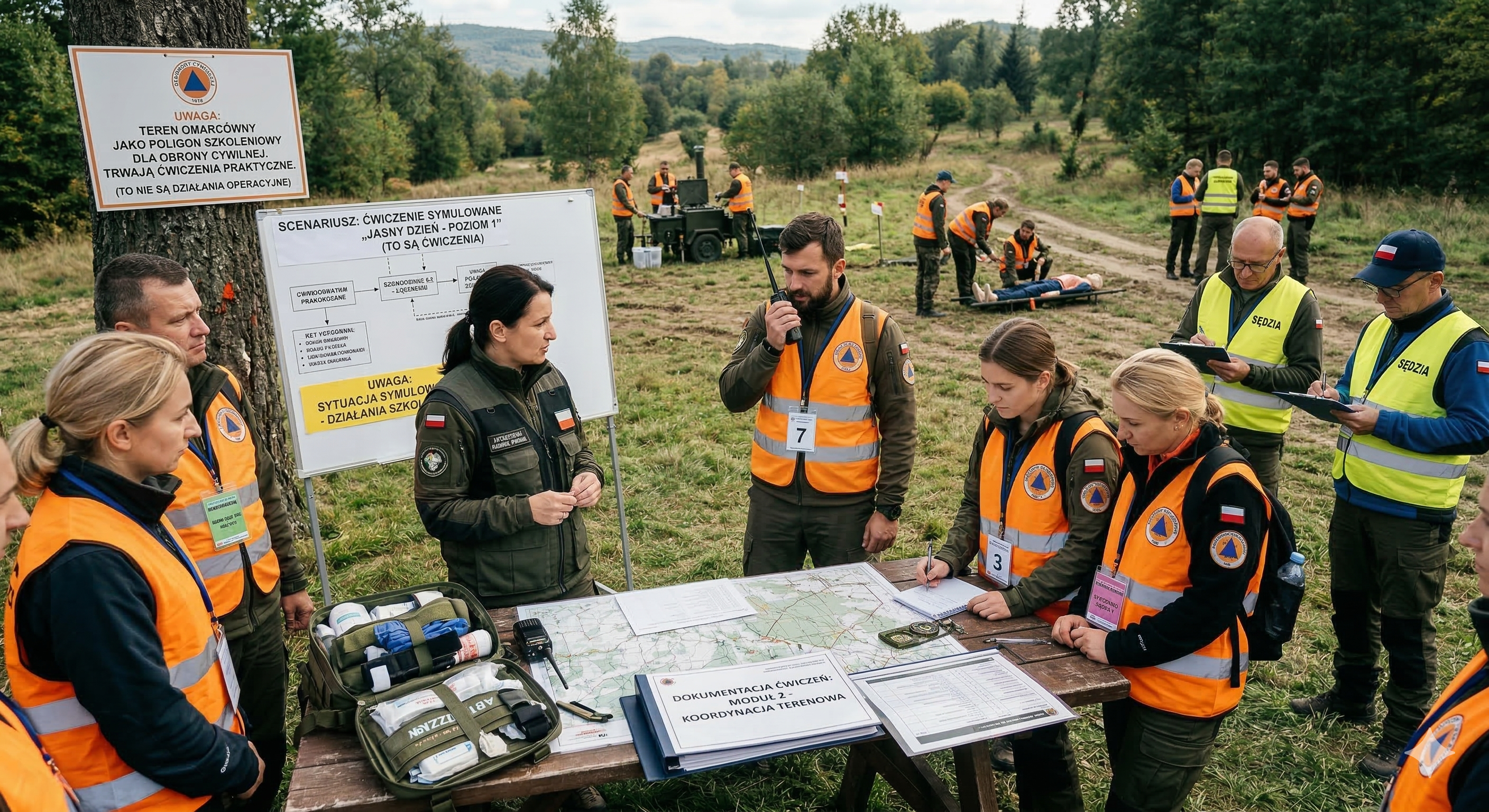
The scope of PSSO competences should include, among others:
- defensive shooting (safety, procedures, decisions under pressure),
- drones and situational awareness (observation, reconnaissance, basics of coordination),
- communications (communication rules, radio discipline, passing on information),
- logistics (organising resources, moving people and equipment, basic planning),
- tactical medicine (first aid under threat and with limited means),
- crisis response (supporting evacuation, securing areas, cooperation with local structures).
This is education that is not meant to replace the state, but to strengthen society: to teach how to act responsibly and effectively before a situation forces improvisation.
Inspired by the Finnish MPK model — but adapted to Poland
The approach is inspired by the Finnish model of civilian training delivered by MPK in Finland. This model shows that a civilian system can build high readiness in society over years — consistently, methodically and on the basis of trust.
At the same time, the key assumption is that Poland does not copy the Finnish system, but adapts it to its own circumstances. We differ in population size, regional diversity, demographic structure, and geographical and logistical conditions.
That is why defence education in Poland should emphasise:
- scale and accessibility (different entry levels, different formats, an easy start),
- standardisation and safety (coherent frameworks, clear procedures, quality control),
- practicality (training “for real situations”, not “for theory”),
- continuity (not one-off events, but a system for maintaining skills).
Defensive shooting ≠ sport shooting
Shooting training is an important part of defence education, but its purpose differs from the sport model. Sport shooting focuses on competition, disciplines and results. Defensive shooting builds readiness to act in a real threat: it teaches safe habits, proper procedures, communication and decision-making under pressure.
This means different emphases in training: more focus on control, responsibility, situational assessment and risk reduction. That is why the concept calls for the introduction of a new, pro-defence firearms licence, which would allow training to be conducted safely, in an orderly way and separately from the sport system.
Instructor potential: experience that can be put to use
A huge and often untapped resource is people with experience: retirees, veterans and civilian enthusiasts. These are people with practical knowledge and skills who today often lack a clear path to pass them on to society within an organised system.
In a civilian education model their role is strategic, because they:
- increase scale (more instructors = more accessible training),
- raise quality (practice, experience, good habits),
- build a culture of responsibility (standards, discipline, an ethos of public service).
This is not “loose volunteering”. It can be an organised instructor potential that genuinely changes the pace at which resilience is built.
Why the army cannot train everyone
The model is based on the principle: civilians train civilians, while the Armed Forces focus on specialist training and maintaining combat readiness.
This approach has a practical rationale:
- mass training of the population is a huge staffing and logistical burden,
- overloading the army with general tasks limits its ability to train itself,
- the state needs a system that works continuously and locally, not only in military cycles.
A civilian defence education system is therefore meant to protect the combat value of the army while raising the readiness of society in a scalable and repeatable way.
A scale that strengthens Poland’s position
If defence education covers a significant part of the adult population, we are talking about millions of trained citizens.
This means:
- greater resilience to external threats,
- a better response to internal crises,
- more credible deterrence,
- a stronger position in Europe and the potential to support other European Union countries in building resilience.
For comparison on a global scale, the example of China is often cited — showing that the number of trained reserves is one of the hard parameters of a state’s readiness.
What defence education should look like in practice
For defence education to work, it must be a system, not a one-off campaign. Citizens need a clear path: entry, development and maintenance of skills.
Key principles of the education programme:
- Development paths and levels – from the basics (safe foundations) to specialisations.
- Regularity – skills need refreshing, because they fade without practice.
- Standards and safety – procedures, instructors, requirements, evaluation.
- Realistic scenarios – exercises “as it will be”, not “as it should be in theory”.
- Cooperation across domains – combining skills (e.g. communications + logistics + medicine), because in a crisis everything overlaps.